10 Questions to Ask a Contractor Before Building Your House in Cebu
- August 11, 2026
- Homeowner Guides
- 13 mins read
Building a house in Cebu is a major investment. Before you sign a construction contract or make your first payment, take time to ask your contractor the right questions.
It is easy to focus on one question:
“How much will it cost?”
But the lowest quotation does not necessarily offer the best value. Two contractors may quote the same house very differently because they have different inclusions, material specifications, construction methods, supervision, payment terms, and exclusions.
A good contractor should be able to explain what you are paying for, who will manage your project, how changes will be handled, and what happens if problems arise.
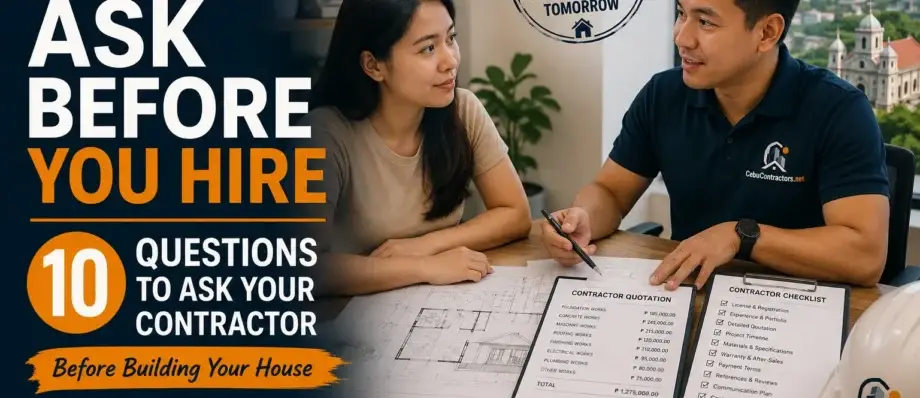
If you are currently interviewing a house contractor in Cebu, here are 10 important questions to ask before you hire.
Quick Checklist: 10 Questions to Ask Your Contractor
Before signing, ask:
- What exactly is included and excluded from your quotation?
- Are you PCAB licensed, and can I verify your license?
- Can I see projects similar to the house I am planning?
- Can I speak with some of your previous clients?
- Who will actually supervise my project?
- What materials and specifications are included in your price?
- What is the payment schedule, and how will progress billing work?
- How will additional works and variation orders be handled?
- What is the construction schedule, and what happens if there are delays?
- What warranty or defect responsibility will you provide after turnover?
Save this list and bring it with you when meeting potential contractors.
Now, let’s look at why each question matters.
1. What Exactly Is Included and Excluded From Your Quotation?
This should be one of the first questions you ask.
Imagine receiving three quotations for your house:
Contractor A: ₱4.5 million
Contractor B: ₱4.8 million
Contractor C: ₱5.2 million
At first glance, Contractor A appears to be the cheapest.
But what if Contractor A excludes waterproofing, selected fixtures, permits, cabinetry, painting, or other works that Contractors B and C have already included?
The three prices are no longer directly comparable.
Before comparing the total amount, understand the scope of work behind each quotation.
Depending on your project, ask whether the price includes:
- Site preparation and temporary works
- Structural works
- Masonry
- Roofing
- Waterproofing
- Doors and windows
- Ceiling works
- Floor and wall finishes
- Painting
- Plumbing and sanitary works
- Electrical works
- Fixtures
- Cabinets and built-in furniture
- Exterior and site development works
- Testing
- Permits and fees
- Mobilization
- Construction cleanup
Then ask:
“What is specifically excluded from this price?”
Exclusions are just as important as inclusions.
A vague quotation can make a low initial price look attractive while leaving many costs to appear later.
2. Are You PCAB Licensed, and Can I Verify Your License?
Ask for the contractor’s:
- Complete registered business name
- PCAB license number
- Current license information
Then verify the information yourself.
The Philippine Contractors Accreditation Board states that under Republic Act No. 4566, as amended, contractors—including subcontractors and specialty contractors—must secure a PCAB license before engaging in contracting business.
Do not rely solely on a PCAB logo displayed on a quotation, website, social media page, or company profile.
Check the official record.
When verifying a contractor, look at the registered contractor name, license number, validity, category, principal classification, and other classifications shown in the record.
If you’re unsure how to do this, read our step-by-step guide:
How to Check if a Contractor Is PCAB Licensed in the Philippines
Remember that a valid PCAB license is an important credential, but it should not be your only basis for choosing a contractor.
3. Can I See Projects Similar to the House I Am Planning?
Don’t simply ask:
“Can I see your portfolio?”
Ask for projects that are actually relevant to yours.
If you are planning a two-storey residential house, a contractor’s portfolio of warehouses or commercial fit-outs may demonstrate construction experience, but it does not necessarily show experience with the type of house you want to build.
Ask to see projects with a similar:
- Building type
- Floor area
- Number of storeys
- Structural system
- Level of finish
- Budget range
- Site condition
If possible, ask to visit both a completed project and an ongoing project.
Completed projects show the finished product.
Ongoing projects can reveal how the contractor actually works.
Observe the site’s organization, material storage, workmanship, safety practices, housekeeping, and supervision.
A polished portfolio shows you what the contractor wants you to see.
An active construction site can tell you much more.
4. Can I Speak With Some of Your Previous Clients?
References can help you understand what happens after the quotation has been accepted and construction begins.
Ask for previous clients whose projects are reasonably similar to yours.
When you speak with them, don’t simply ask:
“Were you happy with the contractor?”
Ask more specific questions:
- Was the project completed reasonably close to the agreed schedule?
- Was the final cost reasonably close to the original contract amount?
- Were additional costs clearly explained?
- Were variation orders documented?
- Was someone regularly supervising the project?
- Was communication good?
- How did the contractor respond when problems occurred?
- Were defects corrected after completion?
And one particularly useful question:
“Would you hire the same contractor again?”
No construction project is completely free of problems.
What you want to understand is how the contractor responds when those problems happen.
5. Who Will Actually Supervise My Project?
The person discussing your quotation may not be the person managing your house during construction.
Ask the contractor:
“Who will actually be responsible for my project once construction starts?”
Then clarify:
- Who is the project engineer?
- Who is the foreman or site supervisor?
- Who supervises the workers daily?
- How frequently will the project engineer visit?
- Who will coordinate with you?
- Who can approve site decisions?
- Who should you contact if there is a problem?
This becomes especially important when a construction company is handling several projects at the same time.
You want to know whether your project will receive appropriate supervision—not simply whether the company has qualified people listed in its organization.
Ask to meet the person who will actually manage or supervise your project before construction begins.
6. What Materials and Specifications Are Included in Your Price?
Be careful with descriptions such as:
“Standard materials included.”
What does “standard” actually mean?
Two contractors can quote the same house using very different assumptions about materials and finishes.
Before signing, understand the specifications being priced.
Depending on the stage of your plans and specifications, clarify important items such as:
- Concrete requirements
- Reinforcing steel
- Masonry materials
- Roofing system
- Waterproofing system
- Tiles and finishes
- Doors
- Windows
- Plumbing fixtures
- Electrical fixtures
- Ceiling materials
- Paint system
- Cabinets and joinery
You don’t necessarily need to choose every tile, faucet, or light fixture before requesting an initial quotation.
But before entering into the final construction agreement, major specifications, allowances, and owner-selected items should be sufficiently clear.
Otherwise, disputes can arise later because the homeowner expected one specification while the contractor priced another.
7. What Is the Payment Schedule, and How Will Progress Billing Work?
Before paying anything, understand exactly when payments become due and what each payment represents.
A construction payment arrangement may involve:
- Mobilization or initial payment
- Periodic progress billings
- Payments tied to construction milestones
- Retention, where applicable
- Final payment
- Turnover requirements
Don’t focus only on:
“How much is the down payment?”
Also ask:
“What work or accomplishment triggers the next payment?”
For example, if payments are based on progress, understand how progress will be measured and documented.
Ask:
- How often will progress billings be submitted?
- How is percentage accomplishment determined?
- What supporting documents will be provided?
- Who verifies the accomplishment?
- When does payment become due?
- Is there retention?
- What must be completed before final payment?
The payment schedule should make sense in relation to the actual progress of construction.
Avoid making major payments based solely on verbal promises about future work.
8. How Will Additional Works and Variation Orders Be Handled?
Changes during construction are common.
You might decide to:
- Upgrade tiles
- Add electrical outlets
- Change windows
- Modify a room
- Add cabinetry
- Change finishes
- Increase quantities
- Add work that was not included in the original scope
These changes can affect both the contract price and construction schedule.
Before construction starts, ask:
“How will additional works and variation orders be priced and approved?”
Clarify:
- Who can request a change?
- Who can approve it?
- Will a written quotation be provided before the work proceeds?
- How will omitted work be valued?
- How will additional time be assessed?
- How will changes be documented?
Avoid relying on arrangements such as:
“Just proceed. We’ll calculate it later.”
That can easily lead to disagreements.
A better process is:
Request → Price → Review → Written Approval → Proceed
Whenever practical, understand the cost and schedule effect before authorizing the change.
9. What Is the Construction Schedule, and What Happens if There Are Delays?
Ask for more than a promised completion date.
Ask:
- When can you start?
- What is the expected construction duration?
- What are the major milestones?
- How was the duration calculated?
- What could delay the project?
- How will delays be documented?
- When can an extension of time be requested?
A residential construction schedule may include major stages such as:
- Mobilization and site preparation
- Excavation and foundation
- Structural works
- Roofing
- Masonry and partitions
- Plumbing and electrical rough-ins
- Architectural finishes
- Fixtures and equipment
- Testing and rectification
- Final inspection and turnover
For projects in Cebu, actual progress may also be affected by weather, material availability, site accessibility, design changes, permit requirements, subdivision restrictions, and other project-specific conditions.
A contractor promising an unusually short construction period is not automatically better.
Ask how that schedule will actually be achieved.
10. What Warranty or Defect Responsibility Will You Provide After Turnover?
Construction responsibility should not become unclear the moment you receive the keys.
Ask what happens if you discover problems after turnover.
For example:
- Roof leaks
- Waterproofing failures
- Plumbing leaks
- Electrical defects
- Hollow or detached tiles
- Paint defects
- Door or window problems
- Other workmanship defects
Ask:
“What defects are you responsible for after turnover, and for how long?”
Then ask:
“Will that be written in the contract?”
You should understand:
- What is covered
- What is excluded
- How defects should be reported
- Who will inspect them
- How rectification will be handled
- Applicable warranty or defect periods
Don’t depend solely on:
“Don’t worry, just call us if there’s a problem.”
Important obligations should be documented.
Bonus Question: What Could Cause the Final Cost to Increase?
This may be one of the most revealing questions you can ask.
Say:
“Based on my plans and your quotation, what could cause the final construction cost to increase?”
A knowledgeable contractor should be able to explain the major risks and assumptions.
Possible causes may include:
- Owner-requested design changes
- Material upgrades
- Additional quantities
- Work outside the original scope
- Unforeseen site conditions
- Incomplete design information
- Changes required during permitting
- Additional work discovered during renovation
- Approved variation orders
- Other circumstances covered by the contract
The goal is not to obtain a guarantee that the price will never change.
The goal is to understand what assumptions the contractor used when preparing the price and how changes will be managed.
If you’re still determining your budget, read our guide on How Much Does It Cost to Build a House in Cebu? before comparing contractor quotations.
Questions a Good Contractor Should Ask You
The interview should not be one-sided.
A serious contractor should also be asking you questions.
Be cautious if someone gives you a supposedly final construction price after seeing only a floor plan or a few pictures.
Depending on the project, a contractor may need to ask:
- Do you already own the lot?
- Are the architectural and engineering plans complete?
- Are the plans approved?
- Is a building permit already being processed?
- What level of finish do you expect?
- What is your target budget?
- When do you want construction to begin?
- Are there subdivision or site restrictions?
- Is the property easily accessible for deliveries?
- Who will make decisions during construction?
- Are any materials owner-supplied?
- Are there existing structures or utilities that could affect construction?
The contractor needs sufficient information to properly understand the project.
Good estimating requires more than simply multiplying your floor area by a price per square meter.
Don’t Compare Contractors on Price Alone
Suppose Contractor A quotes ₱4.5 million and Contractor B quotes ₱5 million.
The ₱500,000 difference means very little until you understand why the prices are different.
Contractor B might include:
- Better specifications
- Additional scope
- More complete finishes
- Waterproofing
- Fixtures
- More project supervision
- Items excluded by Contractor A
Or Contractor A may simply operate more efficiently.
You won’t know until you compare the quotations properly.
Evaluate contractors based on a combination of:
Credentials + Experience + Scope + Specifications + Price + Supervision + Schedule + Contract + Communication
If you’re still deciding between several builders, read our guide on How to Choose a Contractor in Cebu: 10 Things to Check Before You Hire.
Before You Sign: Contractor Interview Checklist
Use this simple checklist after meeting each contractor.
| Question | Checked |
|---|---|
| Inclusions and exclusions explained | ☐ |
| PCAB license independently verified | ☐ |
| Similar projects reviewed | ☐ |
| Previous clients contacted | ☐ |
| Project supervisor identified | ☐ |
| Material specifications understood | ☐ |
| Payment schedule explained | ☐ |
| Variation procedure agreed | ☐ |
| Construction schedule provided | ☐ |
| Warranty/defect responsibilities explained | ☐ |
| Possible cost increases discussed | ☐ |
| Written construction contract reviewed | ☐ |
Don’t treat this as a scoring system where the contractor with the most boxes automatically wins.
Use it to identify information that is still missing before you make a decision.
Find House Contractors in Cebu
Once you know what questions to ask, the next step is finding contractors that fit your project.
CebuContractors.net helps homeowners and property owners discover construction professionals and suppliers serving Cebu.
Depending on your project, you can look for:
- House contractors
- General contractors
- Residential contractors
- Renovation contractors
- Architects
- Engineers
- Electrical contractors
- Plumbing contractors
- Roofing contractors
- Waterproofing contractors
- Structural steel contractors
- Construction suppliers
- Other specialized construction services
Finding a contractor is only the beginning.
Before hiring, independently verify the contractor’s credentials, review previous projects, request a detailed quotation, speak with references, and read the construction contract carefully.
A listing on CebuContractors.net is not an endorsement, guarantee of workmanship, or confirmation of a contractor’s current licensing status. Always conduct your own due diligence before hiring.
Frequently Asked Questions
How many contractors should I interview before building a house?
There is no fixed number that works for every project. However, speaking with several qualified contractors can help you compare approaches, quotations, schedules, specifications, and communication.
The goal is not simply to collect as many prices as possible. Focus on obtaining comparable proposals from contractors who are genuinely suitable for your project.
Should I ask a contractor for references?
Yes. Previous clients can provide useful information about the contractor’s communication, workmanship, project supervision, cost management, handling of changes, and response to defects.
Whenever possible, speak directly with previous clients rather than relying solely on testimonials published by the contractor.
What documents should I ask a contractor to provide?
The appropriate documents depend on the project, but you may need to review the contractor’s business and licensing information, quotation, scope of work, specifications, construction schedule, payment terms, and proposed contract.
For contractor licensing, independently verify current PCAB information through the official PCAB verification system.
Should I choose the contractor with the lowest quotation?
Not automatically.
First confirm that the contractors are pricing comparable scopes and specifications.
A lower quotation may represent good value, but it may also exclude work included in another contractor’s price.
Compare the details before comparing the totals.
What should I check before signing a construction contract?
At minimum, understand the contract price, scope, plans and specifications, payment schedule, construction period, variation procedure, responsibilities of both parties, delays, warranties or defect obligations, termination provisions, and turnover requirements.
For a substantial construction project, consider obtaining appropriate professional or legal advice before signing.
Final Thoughts
The best time to ask difficult questions is before construction begins.
Once work has started and substantial payments have been made, misunderstandings about scope, materials, payment, schedule, and additional costs become much harder to resolve.
Don’t be afraid to ask a potential contractor detailed questions.
A professional contractor should expect homeowners to understand what they are agreeing to.
Before hiring, make sure you know:
What are they building?
What materials are included?
How much will you pay?
When will you pay?
Who will supervise the work?
How long should construction take?
How will changes be priced?
What happens if something goes wrong?
Those answers can tell you much more than the final number at the bottom of a quotation.
If you’re preparing to build a house in Cebu, use CebuContractors.net to discover construction professionals and suppliers, then compare and independently verify potential contractors before making your final decision.
Disclaimer: This article provides general information for homeowners and property owners and does not constitute legal, engineering, architectural, or financial advice. Construction contracts, licensing requirements, project conditions, warranties, and regulatory requirements vary. Verify current requirements with the appropriate government agencies and consult qualified professionals when necessary.